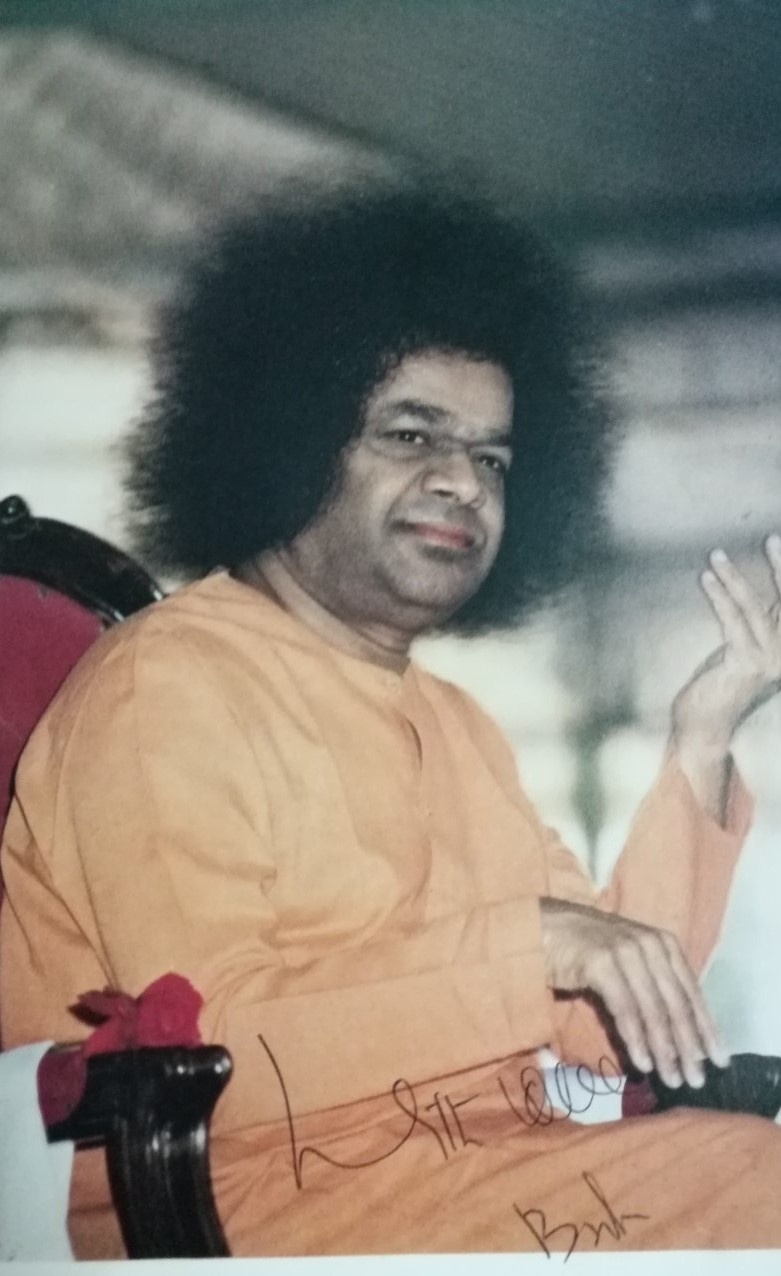
A devotee must constantly be chanting the name of the Lord. Devotion has no fixed limits. At all times and under all situations, the Lord must be remembered. In this age of Kali, people have started making distinctions between tasks that are theirs and those that are for God! They think that doing meditation, contemplation of the Lord and performing rituals of worship are all tasks to be performed for God, whereas all household chores, business, jobs, agriculture and other such tasks are believed to have no connection with God. This kind of division obstructs man form realising Divinity. Devotion implies that which sees no divisions. Hence, there are no dominions like ‘yours and mine’; this is because in this body there is only one God, residing as the life-force.
This has been called Pranopasana by sages of yore, which means worshiping God constantly, irrespective of your activities. You must have seen that when police officers go on duty, they put on their uniforms befitting their ranks. But when they go off-duty, they come back home and wear their own clothes. Similarly, when devotees go on pilgrimage to such Badrinath, Kedarnath, Amarnath, Manasarovar and such other places, they put on a dress called devotion. Upon their return from the pilgrimage, they forget devotion and revert to the worldly view; thoughts related to the household enter into their minds. This is not devotion. Devotion is the constant contemplation of the Lord at all times, places and circumstances. Every effort must be made to experience and enjoy the bountiful joy of devotion with the help of this physical body.
In this heart reside both the human and the Divine;
Both play with each other and separate themselves;
But there is a director who directs this play.
In the same dummy are placed both evil and good.
God is One. Though there may exist good and bad, it is God alone who is in both of these. If Divinity is to be comprehended, it is the principle of the heart that must first be understood; only then will Nature be ours. (SSB 1996, pp. 88-89)